

Janitorial vs commercial cleaning usually comes down to routine upkeep versus deeper and specialty cleaning. The terms can overlap, so the right service depends on what needs attention, how often it needs cleaning, and the conditions inside your facility.
Enterprise Building Services (EBS) helps businesses maintain clean, healthy commercial spaces for employees, customers, and visitors. One facility may need daily restroom and surface cleaning plus periodic floor care, while another may need a lighter schedule with specialty work at certain times.
The service name matters less than what your building actually needs. A practical comparison starts with frequency, cleaning depth, and facility conditions.
This buyer’s resource covers:
- What each type of cleaning usually includes
- Why the terms overlap
- Which approach may fit different facilities
- When regular and deeper services work together
- What to compare before hiring a cleaning company
Our commercial cleaning services include recurring and specialty options for different facility needs. Commercial cleaning service details show where broader cleaning work may fit beyond everyday upkeep.
Why This Confuses So Many Businesses
Janitorial work and commercial cleaning can include many of the same tasks. Cleaning companies may also use the terms differently, so similar proposals can carry different service names.
One company may classify restroom cleaning, vacuuming, trash removal, and surface cleaning as janitorial work. Another may place those same tasks under commercial cleaning. The scope shows what is actually included.
The same issue applies when evaluating a commercial janitorial company. It helps to separate the work by purpose:
- Regular upkeep: Trash, restrooms, vacuuming, and common surfaces
- Routine maintenance: Scheduled work that helps maintain the facility
- Deep cleaning: Heavier work that removes buildup
- Specialty cleaning: Work that may need different equipment, products, or scheduling
Cleaning and disinfecting are also separate tasks. EPA registered disinfectant information identifies products registered for specific disinfecting uses, while cleaning focuses on removing dirt and other material from surfaces.
Cleaning and disinfecting differences show why facilities may treat those tasks differently. Commercial cleaning FAQ answers address other common service questions.
A useful proposal should clearly state the tasks, frequency, surfaces, and periodic work included. That gives a business something concrete to compare.
Janitorial vs Commercial Cleaning at a Glance
Commercial cleaning is a broad term that can include recurring janitorial work. In the comparison below, broader commercial cleaning refers to deeper, periodic, and specialty work beyond everyday upkeep.
| Feature | Janitorial Work | Broader Commercial Cleaning |
|---|---|---|
| Typical frequency | Daily or recurring | Periodic or condition-based |
| Main focus | Regular upkeep | Deeper or restorative work |
| Equipment | Standard cleaning tools | May need specialized equipment |
| Floor care | Sweeping, mopping | Stripping, waxing, deeper treatment |
| Carpet care | Vacuuming or spot attention | Deep extraction |
| Window cleaning | Often interior glass | May include broader interior or exterior work |
| Disinfection | Routine high-touch attention | May involve more intensive treatment |
| Specialty projects | Usually limited | Broader project-based work |
The practical difference is the condition being handled. Regular upkeep manages everyday soil, trash, dust, and common messes. Deeper work addresses buildup, wear, or surfaces that need a different process.
Flooring is a good example. Sweeping and mopping remove everyday dirt, but they do not restore worn floor finish. Our commercial floor care includes stripping and waxing when routine cleaning is no longer enough.
How Janitorial vs Commercial Cleaning Affects Your Schedule
Cleaning frequency should follow the way a building is used. A busy workplace may need restrooms, trash, entrances, and common areas cleaned every day, while deeper floor or carpet work may only be needed when traffic, soil, or wear calls for it.
This is where professional janitorial services and specialty cleaning can work together. Routine service maintains the building day to day, while specialty work handles conditions regular cleaning cannot fully correct.
Routine office cleaning services can form the recurring layer for many workplaces. Three factors help determine what should happen beyond that:
- Frequency: How often does the area need attention?
- Cleaning depth: Is routine upkeep enough?
- Facility conditions: How do traffic, flooring, occupancy, public access, and building use affect the work?
A high-traffic entrance may need frequent cleaning plus occasional floor restoration, while a lightly used meeting room may need far less attention. The schedule should follow actual need rather than a fixed formula.
Which Service Fits Your Facility?
The right cleaning approach changes with the facility. Traffic, flooring, public access, operating hours, shared spaces, and the work performed inside all affect the cleaning mix.
For businesses comparing building maintenance cleaning, these examples show how priorities can change:
| Facility | Routine Priorities | Deeper Priorities | Likely Approach |
|---|---|---|---|
| Medical office | Waiting areas, restrooms, high-touch surfaces | Site-specific sanitation needs | Routine plan plus specific requirements |
| Warehouse | Shared areas, restrooms, traffic zones | Floors and dust-related work | Depends on operations |
| Corporate office | Work areas, break rooms, restrooms | Carpet and floor care | Combined routine and periodic cleaning |
| School | Classrooms, common areas, restrooms | Break-period projects | Routine plus scheduled deeper work |
| Retail | Entrances, customer areas, restrooms | Floor and seasonal buildup | Combined plan |
| Manufacturing | Shared employee areas | Site-specific specialty work | Depends on operations |
| Church | Restrooms and gathering spaces | Event-related deeper cleaning | Routine plus event-based work |
| Property management | Entrances and common areas | Flooring and turnover work | Combined plan |
Some facilities have sanitation or safety requirements beyond general commercial cleaning. Regular commercial service should not be treated as proof that every requirement for a regulated facility has been met.
OSHA workplace sanitation requirements identify general sanitation duties employers can review. Industry-specific obligations still need separate review where they apply.
The building itself should drive the final plan. Industry type gives context, but traffic, surfaces, occupancy, and daily operations determine where routine cleaning ends and deeper attention begins.
Five Questions to Ask Before Choosing a Cleaning Company
A cleaning proposal should start with the facility, not a preset package. This matters when reviewing commercial building cleaning proposals because different prices may reflect different schedules, tasks, exclusions, or periodic services.
Ask these five questions:
- Does the building need daily cleaning?
Busy restrooms, entrances, trash areas, and shared spaces may need frequent attention. - Is the facility open to the public?
Customer-facing areas may need more attention during operating hours. - Does the building have specialty flooring?
Carpet and finished floors may need care beyond routine vacuuming or mopping. - Does the facility have sanitation or compliance requirements?
These should be identified before the scope is finalized. - Does traffic change during the year?
Weather, events, busy seasons, and occupancy changes can increase cleaning needs.
When comparing janitorial vs commercial cleaning, look beyond the wording on the proposal. Compare scope before price. Tasks, frequency, exclusions, and periodic services show what the business is actually paying for.
The Cleaning Pyramid™ Shows How Cleaning Needs Build
Most commercial buildings need more than one level of cleaning. EBS uses the Cleaning Pyramid™ as a simple decision framework for organizing cleaning needs by frequency and depth.
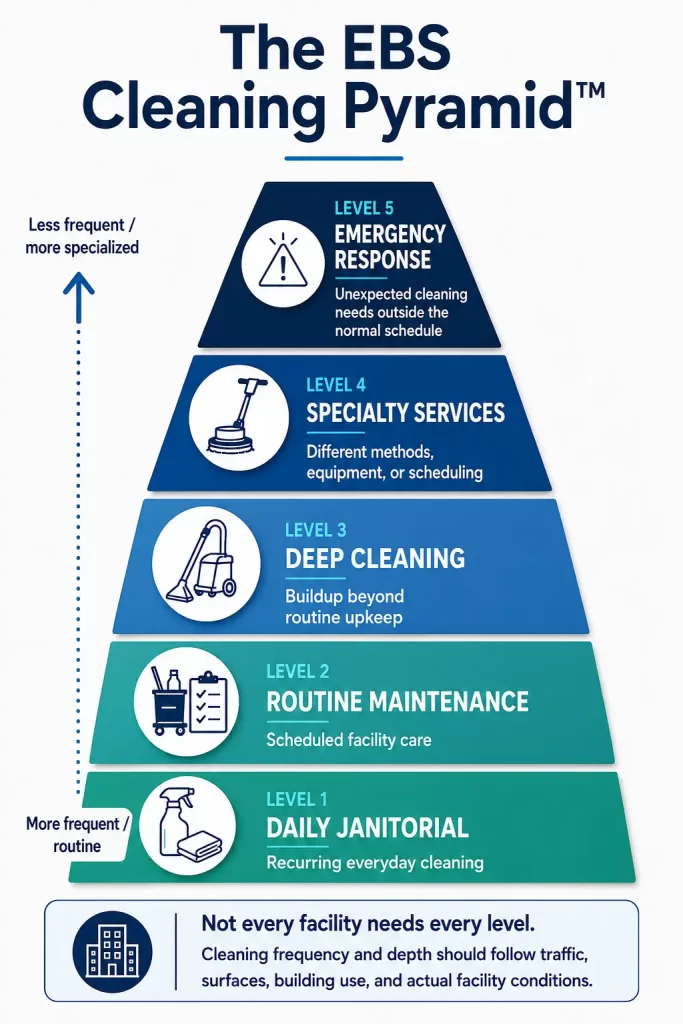
Frequency generally decreases as specialization increases. Higher levels usually happen less often, but they do not replace the regular work below them. The framework also does not mean every facility needs every level or that EBS performs every possible service listed at the top.
For an office, Level 1 may cover restrooms, trash, and common areas. Level 2 may include scheduled detail work, while Levels 3 and 4 can address carpet care or floor stripping and waxing when conditions call for them.
That is why cleaning services for commercial spaces should not be judged by visit frequency alone. The business spring cleaning checklist shows where periodic work can fit as weather, traffic, and building conditions change.
Why Many Businesses Benefit From Both Services
Many facilities need both types of work. Regular service handles ongoing cleaning, while periodic services address buildup, wear, and specialty conditions.
A simple schedule might look like this:
| Timing | Example Work |
|---|---|
| Recurring | Restrooms, trash, common areas |
| Monthly or condition-based | Detail cleaning |
| Quarterly restoration | Carpet extraction or floor restoration as needed |
| Seasonal | Entrances and weather-related buildup |
| As needed | Specialty projects |
Quarterly restoration is only an example. Actual timing should match surface condition, traffic, and facility needs.
A real EBS customer describes the value of having both regular and specialty cleaning available:
“Enterprise Building Services is easy to work with and very accommodating. They always do a great job of cleaning my office. If I need any special services like carpet cleaning its great to know they do that as well. I would highly recommend.”- Greg S.
Greg’s experience shows why janitorial vs commercial cleaning does not always require an either-or choice. Regular office cleaning can handle ongoing needs while carpet cleaning is available when deeper attention is needed.
How EBS Builds Custom Cleaning Programs
A cleaning plan should reflect how the building operates. Size, traffic, flooring, work hours, industry, cleaning frequency, and problem areas all shape the scope.
A facility walkthrough can help identify:
- Building layout and size
- Traffic and shared areas
- Industry and facility use
- Floors, carpet, and key surfaces
- Cleaning frequency
- Budget and service priorities
- Recurring and periodic needs
- A customized proposal based on the facility
Budget matters, but the scope still needs to fit the building. Cutting necessary tasks only to lower the price can create cleaning gaps later.
EPA’s Safer Choice program identifies qualifying products that meet its criteria for safer chemical ingredients. Product selection still needs to match the task, surface, label directions, and facility requirements.
Our commercial cleaning experts focus on practical commercial cleaning needs, while commercial cleaning company information gives businesses more information about EBS and its services.
Match the Cleaning Plan to Your Building
The right decision is not choosing one cleaning label over another. It is matching the cleaning scope to how your facility operates.
Compare the work, not just the service name. Look at the tasks, frequency, surfaces, exclusions, and deeper services before choosing a cleaning company.
Ready to Match Cleaning to Your Facility?
The best option is a cleaning plan that matches your building’s traffic, surfaces, schedule, and actual needs. For many businesses, that means regular janitorial work supported by deeper commercial cleaning when conditions call for it.
If janitorial vs commercial cleaning still leaves you deciding what belongs in your plan, EBS can help identify the right mix without adding services you do not need.